

Back
Projects & practice
RTK: filter shell output before it reaches a coding agent
RTK filters test, Git, search, and build noise before command output enters model context, applying context engineering at the tool-output boundary.
阅读中文原文 · Translated from the original article; source publication date retained
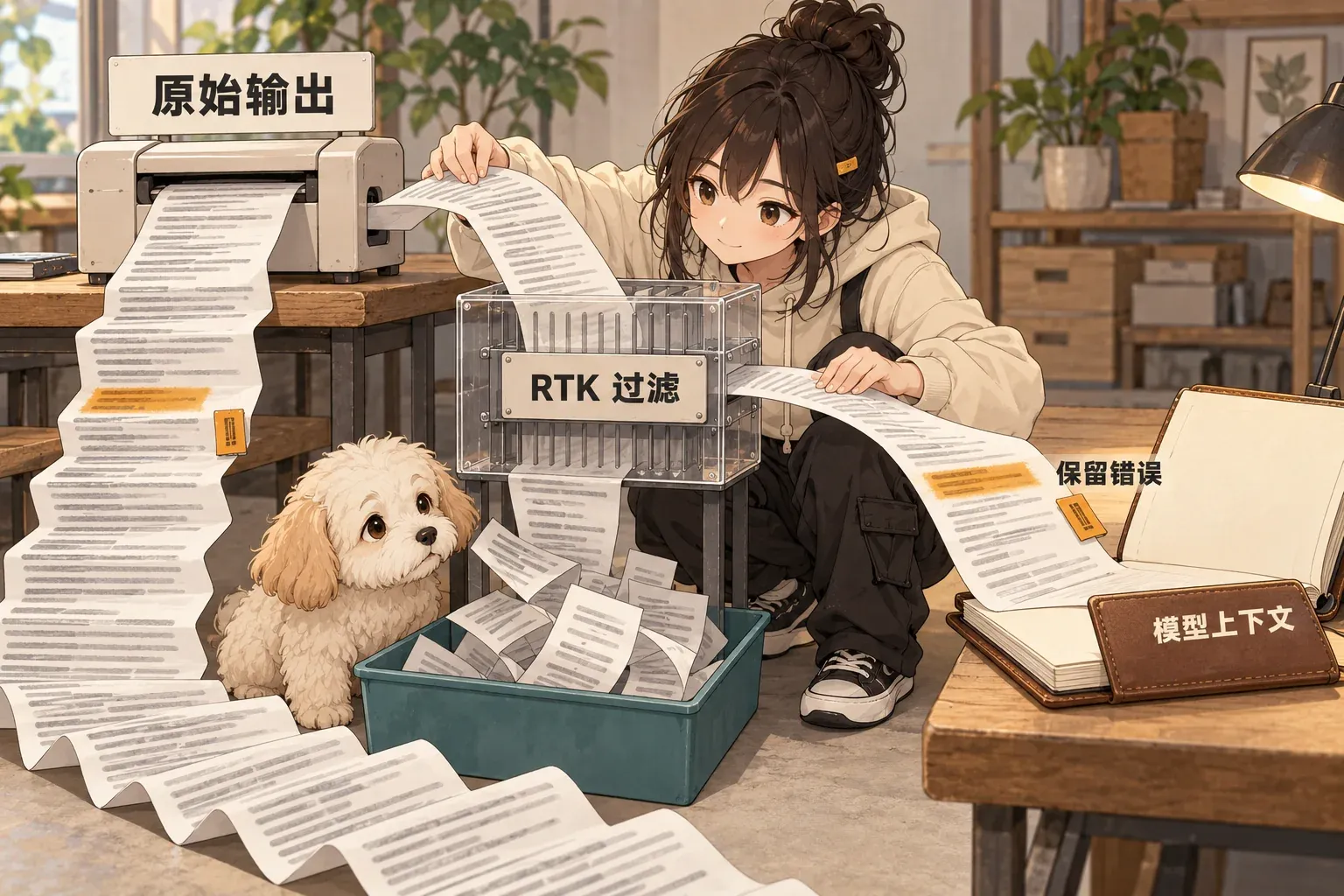
The original cover retains its Chinese labels. They mean “raw output,” “RTK filtering,” “retain errors,” and “model context.” The illustration shows long command output passing through a filter while error details continue into the model’s context.
The 30-second version#
When a coding agent runs git status, pytest, cargo test, or a search command, it often receives lengthy output. Much of it consists of success logs, repeated lines, or formatting noise.
RTK sits between the agent and the shell. Commands run as usual; RTK processes only the returned results. Test output can retain only failures, Git status can use a compact format, and search results can be grouped by file.
The model sees less text, but the underlying commands still run in full.
The most important qualification is that the project’s “up to 90%” claim concerns Bash output compression, not a 90% reduction in the total bill.
Why it is interesting#
Many coding-agent optimizations focus on models, prompts, or context compaction. RTK chooses a more specific point: the last stage before tool results enter the model. This is a useful place for an engineering solution. You do not need to teach the agent to “read fewer logs.” A hook can rewrite shell calls directly, with a different filter for each command type. Failures, exit codes, and stderr still need to be retained. Today’s commit illustrates the difficulty. The project fixed stdout-only filters swallowing stderr. Compressing output must not come at the cost of losing errors.
3 designs worth borrowing#
1. Filter at the tool boundary#
The agent does not need to invoke rtk explicitly every time. A hook or plugin can rewrite shell commands before execution. Putting the rule in the runtime is more reliable than putting it in a prompt.
2. Filter by command type#
Useful information differs between git status, tests, lint, and search. RTK does not use one general-purpose summarizer. It defines a different structure for each command type, helping prevent a model-generated summary from dropping error details.
3. Define what the measurements mean#
The README explicitly says that percentages concern Bash output only and that absolute token counts are estimates calculated as bytes / 4. Every agent optimization tool can borrow this practice. Define what you measure before discussing the gains.
How this connects to my work#
You can apply this boundary directly when working on agent runtimes, tool calling, and evaluations. First, send tool output through a deterministic output adapter. It handles deduplication, truncation, grouping, and conversion into structured fields. Second, designate error fields that must not be lost. Exit codes, stderr, failing test names, and key stack traces need a retention policy. Third, evaluate more than task success rate. Record each tool type’s raw byte count, bytes sent to the model, error-retention rate, added latency, and final task success rate. This lets you determine whether shorter context and better task outcomes actually occur together.

End of article · Back to writing
Comments
Comments are public and managed through GitHub Discussions.
Preparing the comment section…
Sign in with GitHub once the comment box is ready, or open the repository discussions directly. Open GitHub Discussions ↗Comments are published to the public discussions of the lora-sys/loraSys repository.