
No-GPU concept labs
Build a mental model in the browser before installing CUDA, a model, or a serving stack.
A Chinese-first, browser-based learning path for PagedAttention, continuous batching, KV and Prefix Cache, CUDA Graphs, quantization, and distributed inference.
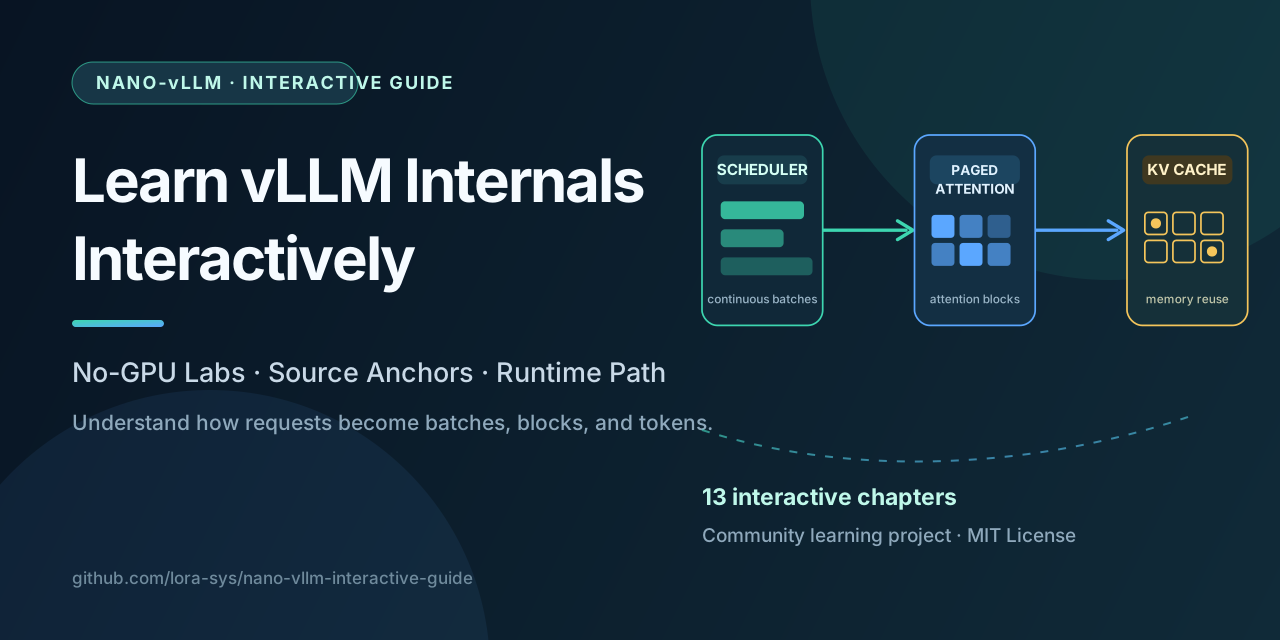
vLLM is easiest to use after its system mechanisms make sense. This guide begins with the questions that typically block a first reading of inference-engine code: How does one request become a batch? Why are KV blocks paged? Why are prefill and decode scheduled differently? Where does cache reuse stop?
The main teaching content is in Chinese. This English discovery page provides a map for international readers and contributors; the interactive labs and source anchors are the recommended way to explore the guide.
IMPORTANT
This is an independent community learning project, not official documentation for GeeeekExplorer/nano-vllm. Browser labs and teaching traces are conceptual learning artifacts, not real GPU traces or benchmark measurements. Use the upstream source code and documented runtime experiments as the final authority.
| Layer | What you do | What you gain |
|---|---|---|
| Concept path | Change state in a browser lab and predict what happens next. | A visual mental model for an otherwise abstract mechanism. |
| Source path | Follow the source map and read the smallest relevant code region. | A concrete link from an idea to the upstream implementation. |
| Runtime path | Run the optional CUDA setup and examine a real execution environment. | Evidence that distinguishes system behavior from a teaching simulation. |
| Area | Questions you can investigate |
|---|---|
| Scheduler and batching | When can a request enter, leave, or share a batch? |
| PagedAttention and KV Cache | How do block allocation and cache layout change memory behavior? |
| Prefix Cache | What may be reused, and what conditions end reuse? |
| Prefill and decode | Why do prompt processing and token-by-token decoding have different bottlenecks? |
| Sampling and parallelism | How do candidate selection and distributed execution alter the serving path? |
| CUDA Graph and benchmarking | What is stable enough to capture, and what evidence is required for a performance claim? |
Start from the learning roadmap · Read the source map · Check source and version notes